
Arizona Auto Glass Law Guide
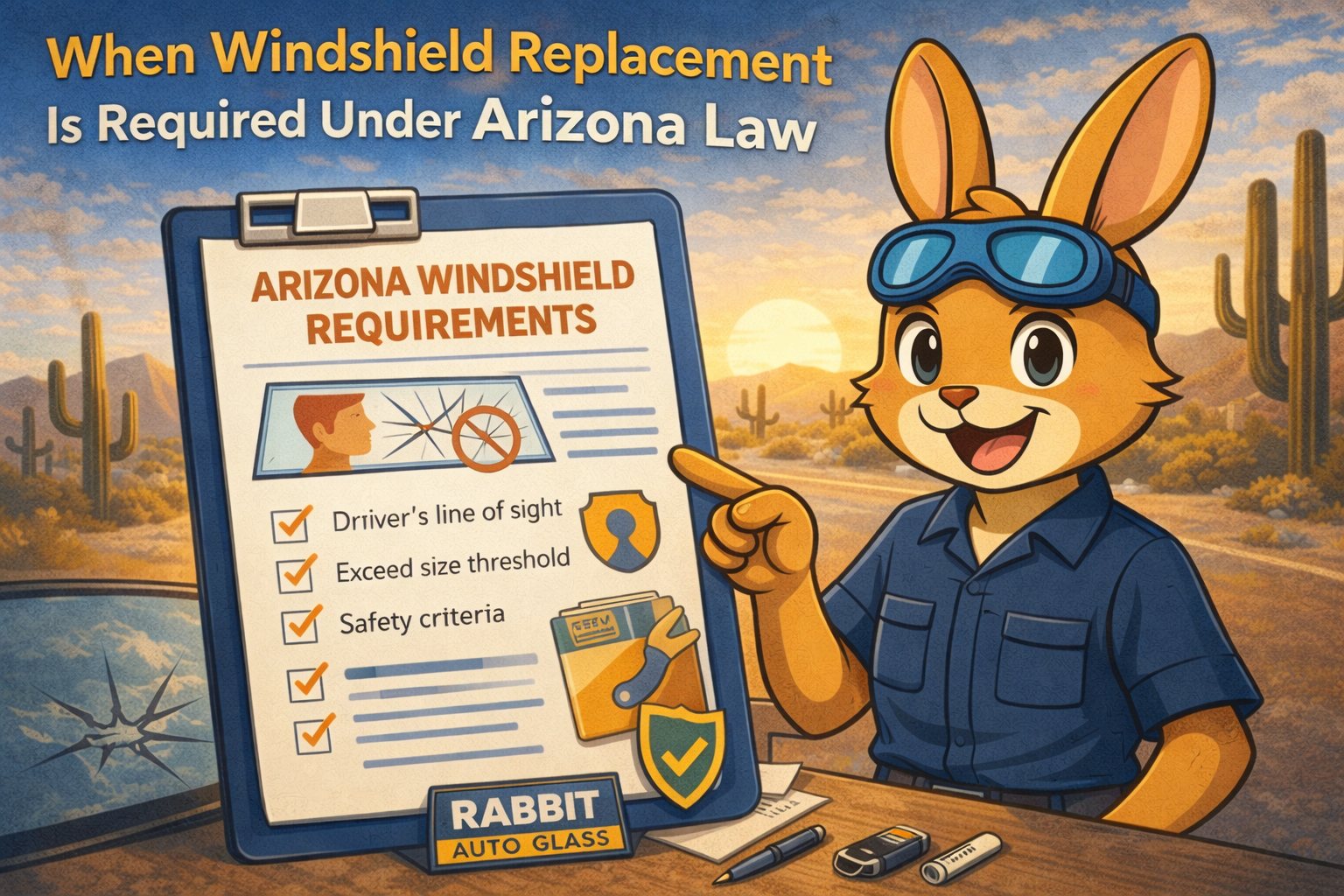
When Windshield Replacement Is Required Under Arizona Law
At Rabbit Auto Glass of Phoenix and Tucson, we are often asked when Arizona law actually requires a windshield replacement instead of a repair. Arizona does not publish a single size based statute for cracks or chips, but it does enforce safety, visibility, and equipment standards through vehicle code, inspection rules, and federal adoption. Replacement becomes required when damage interferes with the driver’s clear view, compromises structural safety, or cannot meet repair standards. Below, we explain what Arizona law truly requires, how insurers apply those rules, and how to stay compliant.
What Arizona Law Requires for Windshield Safety
Arizona enforces windshield safety primarily through Arizona Revised Statutes Title 28, which governs vehicle equipment and safe operation. Windshields must allow a clear view of the roadway and may not be in a condition that creates a safety hazard. Damage that obstructs the driver’s vision, causes distortion, or weakens structural support can render a vehicle unsafe to operate.
Arizona adopts federal motor vehicle safety standards for glazing and installation practices. These standards treat the windshield as a structural safety component that supports roof strength and proper airbag deployment. A windshield that cannot be restored to safe condition through repair must be replaced.
Source, Arizona Revised Statutes Title 28 vehicle equipment and safety
Source, National Highway Traffic Safety Administration glazing safety overview
When Repairs Are Allowed vs When Replacement Is Required
Arizona law does not specify exact crack lengths or chip diameters. Instead, the determining factors are visibility, safety, and structural integrity. Repairs may be allowed when damage is minor, outside the driver’s primary viewing area, and does not weaken the laminated glass layers.
Replacement is required when damage intrudes into the driver’s line of sight, spreads across laminate layers, reaches the windshield edge, or causes distortion. Damage that cannot be repaired to meet safety and visibility standards must be replaced, regardless of size.
Arizona Department of Transportation guidance and law enforcement standards focus on whether the vehicle can be safely operated, not cosmetic appearance. Local reporting from AZ Central has highlighted that visibility obstruction is the most common enforcement trigger.
Source, AZ Central reporting on vehicle safety enforcement in Arizona
How Insurance Coverage Interacts With Arizona Law
Insurance coverage does not determine whether replacement is legally required. Safety standards do. If a windshield cannot be repaired safely, insurers typically approve replacement because operating the vehicle would otherwise violate safety requirements.
Arizona does not mandate free windshield replacement. Coverage depends on policy terms, including comprehensive coverage and deductibles. Some insurers offer zero deductible glass endorsements, but this is contractual, not statutory.
For a consumer focused explanation of coverage realities in Arizona, see the following resource.
Documentation and Compliance Requirements
When replacement is required, proper documentation protects both the driver and the shop. We document damage location, visibility impact, and structural concerns before replacement. Installation records include technician credentials, adhesive specifications, curing times, and post installation checks.
These records support insurance claims and demonstrate compliance with Arizona safety requirements. In the event of disputes, documentation is often the deciding factor.
Choosing a Compliant Auto Glass Shop in Arizona
Selecting a shop familiar with Arizona law reduces risk. Verify that technicians are certified, adhesives meet federal safety standards, and calibration procedures are followed when required.
At Rabbit Auto Glass of Phoenix and Tucson, we install windshields to meet safety standards, not just insurance minimums. Proper installation protects occupants, preserves vehicle value, and avoids compliance issues.